
Stop 8: The Lookout
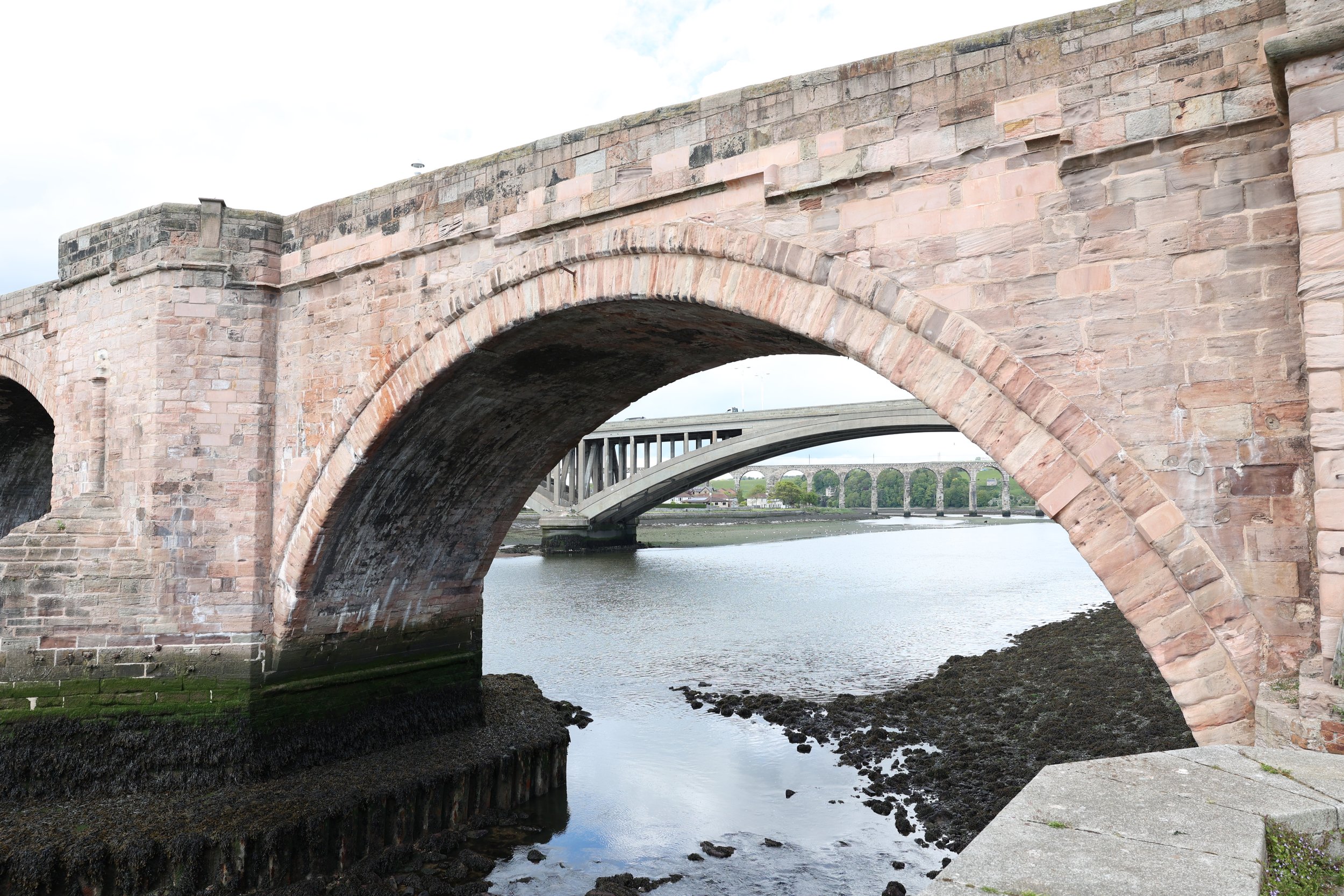
From the Lookout at the end of Berwick’s Old Bridge we can see both up and downstream.
Bridges
Of course the most famous landmarks at this point in the tour are the three iconic bridges.
Berwick Bridge (or the Old Bridge for obvious reasons) was built during the 1600s and was opened to traffic in 1624. It was not fully completed until 1632.
The Royal Tweed Bridge was begun in 1925 and opened by Edward, Prince of Wales in May 1928. It is known locally as the New Bridge, despite being almost 100 years old. It is made of Ferroconcrete and at the time of its construction the arch nearest the Berwick side of the Tweed was the longest reinforced concrete arch in Britain.
The Royal Border Bridge carries the East Coast Mainline across the Tweed and has done since it was opened by Queen Victoria in 1850. She stayed in Berwick all of 12 minutes to perform the ceremony before boarding her train again bound for Balmoral.
The Quayside
Nowadays the quayside is a quiet space where you can escape the hustle and bustle of the town for a coffee or take a boat trip up the Tweed. But rewind to any point before 1979 and it would have been a very different place.
Historically it was the hub of Berwick’s trade, with all imports and exports coming and going from the quay until the building of the Tweed Dock 150 years ago. Even after that time the quay was still thick with boats tied up during the herring season, this industry only dwindling in the 1930s.
Shipbuilding
Shipbuilding has been an important industry on the Tweed, both on the Quayside and on the south bank of the river at Tweedmouth for centuries.
The first yard on the Quayside was founded by Arthur Byram, famous for building the Berwick Smacks, a very fast sailing ship used to transport cargo and passengers to places such as London.
His yard closed in 1878 and ship building here didn’t begin again until 1950. Between 1950 and 1979 around 130 vessels were built here of all shapes and sizes, the last being Audela, a very impressive schooner.